
AI Boat Buying Advice: Where Artificial Intelligence Helps—and Where It Can Cost You Thousands
Can AI help you buy a boat? Yes. Should you trust AI to determine what a boat is worth? Absolutely not.
Expert Advice Still Comes from Experience
Expert advice, in most cases, comes from decades of real-world experience. Buying a boat is no exception.
AI-driven boat buying advice can be useful, but relying on AI alone—especially when it comes to determining a boat's value—is a dangerous mistake.
I can't count how many times each day I see advertisements for a "Free AI Boat Valuation." The problem is that most AI valuation tools simply scan the internet, find similar boats currently listed for sale, and average the asking prices.
Ladies and gentlemen, asking prices are not actual selling prices.
Many boats remain on the market for a year or longer because they're overpriced. Those listings don't represent market value—they represent boats that haven't sold.
At Global Yacht Exchange, we've developed a valuation tool called Accu-Value. The difference is that it doesn't rely solely on artificial intelligence. It combines AI with decades of practical experience from some of the world's leading yacht brokers, along with guidance from an experienced team of software developers.
AI is part of the formula—not the entire formula.
Determining Accurate Boat Value
The term ACV stands for Actual Cash Value.
In simple terms, ACV is the final amount a boat actually sells for after negotiations, survey findings, repair credits, and all adjustments have been completed.
That final number is what matters.
If you rely strictly on the average AI valuation tool, you could end up paying significantly more than the boat's true market value. In some cases, that difference can exceed 25%.
That doesn't mean every boat sells for 75% of its asking price. It's nowhere near that simple.
Every boat is different.
Factors including:
Overall condition
Engine hours
Maintenance history
Equipment upgrades
Survey results
Cosmetic appearance
Service records
...all influence what a boat is actually worth.
AI certainly has its place, and it's improving every day. Maybe someday it will become exceptionally accurate.
Personally, I believe it's also being overused.
Marine Industry Expertise Still Matters
AI may eventually become an excellent boat-buying assistant.
We're just not there yet.
There will never be a substitute for common sense and advice from a bona fide marine professional with decades of practical experience.
AI can't walk around a boat.
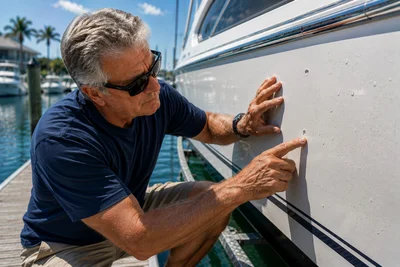
It can't notice stress cracks in the gelcoat and determine whether they indicate serious structural problems or are simply cosmetic.
It can't determine whether a boat has osmotic blisters. If it does, how serious are they? How many are there? How deep do they go? Are they only in the gelcoat, or have they gone into the fiberglass mat? Are the few you see isolated, or do they represent hundreds more waiting to appear?
It can't hear a valve tap.
It can't smell burnt wiring.
It can't recognize subtle vibrations during a sea trial. I can feel the slightest issue through my feet if I'm standing or through my butt if I'm sitting.
Experience still wins.
For years I've told people something that usually gets a laugh:
"Your wife could probably buy a good boat."
Why?
Because buying a quality boat is often a visual game.
When you walk up to a boat and the gelcoat shines, the engine room is spotless, the upholstery looks nearly new, the bilges are clean, and the entire boat sparkles, that boat usually flies through inspection.
Boats don't stay that way by accident.
Someone cared enough to maintain every part of it.
Now compare that with the seller who says:
"I maintained it mechanically, just not cosmetically."
Don't walk.
Run.
People are generally either conscientious or they aren't.
If someone doesn't mind oil sitting in the bilge, faded upholstery, torn canvas, oxidized gelcoat, and obvious neglect, there's a reasonable chance they weren't particularly concerned about servicing the heat exchangers or performing routine maintenance either.
Appearance doesn't guarantee mechanical perfection.
But neglect often tells a story.
Boat Buying Is Already Complicated Enough
Buying a boat is already one of the most complicated purchasing processes most people will ever experience.
Consider everything involved:
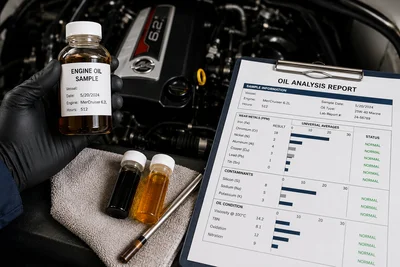
Oil samples sent to laboratories
Twenty-plus elements analyzed in engine oil reports
Forty-page marine surveys
Moisture meter readings
Mechanical inspections
Sea trials
Engine diagnostics
Now we're adding AI opinions into an already complicated process.
That's a lot to sort through.
As of today, AI is still another opinion—not the final authority.
AI Can Be Wrong—And Very Confident
One of the biggest challenges with AI is knowing when it's giving you reliable information and when it's simply filling in the blanks.
AI doesn't always admit it doesn't know something.
Sometimes it produces answers that sound extremely convincing—even when they're completely wrong.
If you're experienced enough to recognize the difference, AI can be an outstanding research tool.
If you're not, it can lead you in the wrong direction with complete confidence.
AI Boat Buying Summary
Don't misunderstand my point.
Some uses of AI are genuinely impressive.
Recently I intentionally tried to throw AI a curveball.
I asked:
"On an older carbureted inboard gasoline engine, what would cause the engine to pop back through the carburetor?"
Its response included:
A lean fuel mixture caused by a faulty accelerator pump
A vacuum leak
Incorrect ignition timing
Those are all legitimate possibilities.
AI got that answer right.
Credit where credit is due.
The message isn't that AI is bad.
The message is balance.
Use AI as one tool—not the only tool.
When buying a boat, use every resource available to you:
Hire a SAMS or NAMS Accredited Marine Surveyor.
Have the engines inspected by the manufacturer or an authorized dealer.
Buying a boat with Yamaha outboards? Hire a Yamaha dealer.
Buying Caterpillar diesels? Hire an authorized Caterpillar technician.
Modern marine systems have become increasingly specialized. Brand-certified technicians often know details that a general mechanic—or AI—simply won't.
Common sense, experienced professionals, quality inspections, and AI can all work together.
That's a much safer approach than relying on AI alone.
And above all else...
Your wife's opinion will probably keep you out of trouble in more ways than one.