
How to Choose the Right Boat Propeller: Diameter, Pitch & RPM Explained
Determining the Right Prop
Prop selection is a serious endeavor. Too much diameter or pitch can destroy engines in a very short order.
First, let’s get my qualifications out of the way, because most errors come from boaters listening to unqualified people who love making boat owners think they’re some sort of expert.
I traveled all over the world as Cummins Engine Company’s troubleshooter and also worked for Detroit Diesel and Caterpillar troubleshooting engine failures, including a great deal of forensic work determining the causes of failures. So yes, I am qualified.
It’s also worth mentioning the number of boaters with very little experience who somehow become instant experts the moment another boat owner asks a question. It’s a truly strange phenomenon that never seems to go away.
A boat owner once said to me, “My friend said those engines suck.”
My response was, “I’ll bite. What does your friend do for a living?”
His reply was, “He’s a dentist.”
Need I say more?
A qualified marine professional isn’t that hard to spot. The technician at the prop shop knows a lot about propellers. The guy in the slip next to you is like taking medical advice from someone you met at the gym.
Understanding the Three Dimensions of Propeller Sizing
There are three dimensions you care about: diameter, pitch, and bore size.
Diameter
Diameter is simply the overall diameter of the propeller.
Pitch
Pitch is how far the propeller travels with one complete revolution.
Imagine you have a giant block of Styrofoam and you spin the propeller one full revolution, driving it into the Styrofoam. How far did it travel with that one complete revolution? That’s pitch.
Bore Size
Bore size is simply the size of the hole in the center of the propeller. It needs to match your shaft size.
Propellers are stamped even after they’ve been altered. If you look closely, you’ll see something like 24 x 22. The first number is always the diameter, while the second number is the pitch.
A prop shop can alter pitch to some degree. They can also reduce diameter, but they cannot increase it. So be sure before requesting that the diameter be reduced.
Propeller Materials
Inboards typically use brass, bronze, or Nibral, a high-performance alloy of nickel, aluminum, and bronze (roughly 81% copper, 10% aluminum, 5% nickel, and 5% iron).
Nibral is a much harder material, which means less flexing under load. The harder the propeller, the less it flexes, making it the preferred choice for today’s high-horsepower cruising boats.
Weed whackers—I mean outboards…sorry, I had to.
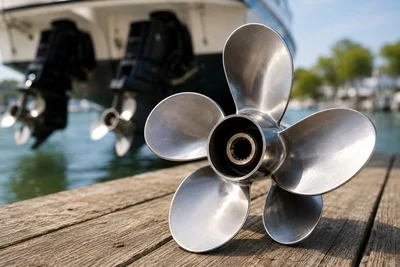
Outboards typically use aluminum or stainless-steel propellers.
Lugging, Overspeed & Engine Damage
If your engine is governed to turn 2,350 RPM and you have too much propeller—either too much pitch or too much diameter—and the engine only reaches 2,100 RPM, you can destroy the engine in a very short time.
Without getting too technical, the engine is in a condition called lugging, meaning the crankshaft bearings are overloaded. Think of driving a truck uphill while leaving it in too high of a gear.
A lug condition destroys the bottoms of the main crankshaft bearings while damaging the tops of the rod bearings.
An over-rev condition does the exact opposite. An overspeed condition damages the tops of the main crankshaft bearings and the bottoms of the rod bearings.
The entire prop-sizing challenge exists because an engine’s rev limiter will allow it to reach governed RPM with no propellers installed. That means it’s entirely possible to have props that are too small—not enough diameter or not enough pitch—and still see the engine reach governed RPM.
The only clue would be poor performance.
It’s actually pretty rare to see a boat with the wrong props. Unless you know of several identical boats with the same engines that consistently perform much better than yours, don’t start playing games with propellers.
Poor performance can come from many other causes, including fuel delivery problems, turbocharger issues, dirty bottoms, or drivetrain problems such as bent shafts.
If you know two identical boats with the same engines and they’re noticeably faster, after you’ve ruled out engine performance issues, then it’s time to compare propeller sizes.
One or two knots?
Leave her alone.
Prop Sizing Tools & Expectations
Most propeller manufacturers, such as Michigan Wheel, offer free online prop-sizing calculators. Enter your engine horsepower, governed RPM, transmission ratio, boat length, beam, displacement, and both actual and desired speed to get a starting point.
It’s just that—a starting point.
If you get it perfect on the first try, go buy a lottery ticket because you’re one lucky individual.
Be forewarned: you’re not going to turn a legitimate 28-knot cruising boat into a 32-knot cruiser by playing games with your wheels. You’ll only risk damaging healthy engines, and you probably won’t make the boat any faster or significantly improve fuel economy.
All propellers are designed for maximum efficiency at full RPM—where almost nobody runs continuously.
The solution is often something called cup.
Years ago, cups were rated from 1 through 11, with 11 being the most aggressive. Today you’ll usually hear the terms mild, medium, and severe. Old-school guys still use the numbers.
The more aggressive the cup, the more efficient the propeller becomes at mid-range cruise RPM. You might gain a knot or two and see a slight improvement in fuel consumption.
Don’t expect dramatic gains, but why not take what you can?
As a rule of thumb, the difference from a mild to a severe cup is roughly equivalent to one inch of pitch or one inch of diameter, or about 125 RPM.
Aluminum vs. Stainless Steel Propellers
Now for a little controversy.
If you have a pair of outboards with aluminum propellers, don’t expect huge gains by switching to stainless steel.
I can already see my email inbox filling up with people telling me I have my ass on crooked.
What I can tell you is I’ve lost track of how many times I’ve watched people spend that money with little or no noticeable improvement in speed or fuel economy.
Aluminum props are designed so that if you strike something, one of the blades may break or the hub may spin before serious damage occurs.
With stainless steel props, you stand a much better chance of destroying a lower unit.
I recently saw the shock load from a stainless-steel prop striking a substantial metal object snap the crankshaft.
The hub is a press-fitted collar in the center of the propeller with female splines, held in place by a rubber grommet. The outboard shaft has matching male splines.
Most of the time, if you hit something hard enough, the rubber breaks free and the hub spins inside the propeller. You simply press in a new hub, which is a whole lot cheaper than replacing a lower unit—or a broken crankshaft.
RPM, Fuel Issues & Propeller Dynamics
Most weed whackers—I mean outboards—turn around 6,000 RPM. Their internal rev limiter prevents them from spinning any faster.
If an engine is rated at 300 horsepower, it only develops that full power at its rated RPM.
There are some interesting nuances here.
If one engine has a clogged fuel filter that limits it to 3,500 RPM, it can actually prevent the healthy engine beside it from spinning much faster.
The dynamics of propellers are amazing.
I’ve seen 3-inch steel shafts twist because the propeller simply cannot slip in the water.
Hard to believe?
It’s 100% true.
If props slipped freely in the water, your boat wouldn’t move forward at all.
Smoke, Turbos & Performance Clues
We could go much deeper into the technology, but I’m not sure it would serve you.
Knowing these basic principles should keep you out of trouble.
Black smoke means there’s too much fuel for the available air.
When you first throttle up to plane off, a small puff of black smoke is perfectly normal. The fuel injection system senses the increased load and briefly adds extra fuel while the turbocharger spools up from increased exhaust gas temperature (EGT).
That puff of black smoke should clear quickly and become nothing more than white steam that dissipates.
Lingering white smoke is unburned fuel and is often an indicator of water contamination in the fuel.
If your boat has performance problems and produces excessive black smoke, it’s either overloaded from the wrong propellers or, on older boats, the turbocharger isn’t doing its job.
Newer electronically controlled engines don’t usually give you that telltale black smoke if the turbo isn’t producing boost. The ECM—or whatever the manufacturer calls its computer—simply won’t allow that extra fuel for emissions reasons.
We’ve probably already gone deeper than necessary for this discussion.
Hopefully, you now have enough basic knowledge to make some informed decisions.
There’s also the matter of three-blade, four-blade, and five-blade propellers.
To keep yourself from pulling your hair out, stick with what’s currently on the boat unless there’s a dramatic issue. Most of the time, the number of blades is already correct.