
Boat Loans: What Every Serious Boat Buyer Needs to Know Before Applying
Buying a boat should be exciting. Whether you’re purchasing your first center console, moving up to a larger yacht, or buying the boat you’ve always wanted, securing a boat loan can sometimes feel like walking through a minefield.
Most buyers assume that if they have good credit, a reasonable down payment, and steady income, financing should be straightforward. While those factors certainly matter, I’ve found that one of the biggest challenges is something many buyers never consider: how the boat is valued.
After selling more than 1,000 boats and working with boat loan lenders for over 25 years, I’ve watched excellent financing deals fall apart—not because of the buyer’s credit—but because of inaccurate boat values and poorly prepared survey reports.
Here are the most important things every serious boat buyer should know before applying for a boat loan.
1. Your Biggest Financing Challenge May Be the Boat’s Value
Most banks rely heavily on published pricing guides such as NADA, BUC, ABOS, and other marine valuation books. Unfortunately, these values are not always accurate.
Some boats are significantly undervalued, while others are priced well above their actual market value.
For example, a Cabo that is truly worth $350,000 may appear in the pricing guides at only $250,000. Since many lenders finance only 80% to 90% of the published value, an otherwise qualified buyer putting $100,000 down may still have trouble obtaining enough financing.
Conversely, a Carver worth $350,000 may be listed in the valuation guides at $450,000. In that situation, the bank may actually lend more than the boat is worth.
The irony is that lenders sometimes decline excellent loans while approving riskier ones simply because the pricing guides don’t accurately reflect the market.
2. Review the Total Deal Before You Get Too Far
Before you get too far down the path, use what I call the RTD Method—Review the Total Deal.
Research how the boat you’re considering is valued in the major pricing guides. If the boat appears undervalued, you’ll want to make sure your marine surveyor is willing to determine fair market value based on recent comparable sales, not simply what’s printed in a valuation book.
Many surveyors rely heavily on book values and hesitate to deviate from them.
The more experienced surveyors will research recent sales of the same year, make, and model before determining market value. Before hiring a surveyor, ask if they are willing to support their valuation with comparable sales when appropriate.
That conversation can save your deal before it ever becomes a problem.
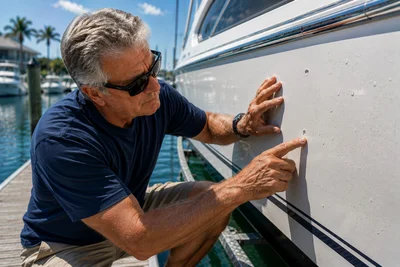
3. The Marine Survey Can Make or Break Your Boat Loan
Most lenders use the marine surveyor’s valuation as one of the primary factors when approving a boat loan.
Choosing the right surveyor is one of the most important decisions you’ll make during the buying process.
Some surveyors rely almost entirely on pricing books. Others consider:
· Recent comparable sales
· Overall condition
· Equipment upgrades
· Maintenance history
· Current market demand
One piece of advice I always give buyers is this:
Don’t discuss value with your surveyor until after the survey is completed.
Allow the surveyor to inspect the boat objectively. If you already know they refuse to look beyond outdated book values, consider hiring someone else before the inspection begins.
It only takes a few minutes to determine whether a valuation issue could jeopardize your financing.
Sometimes it may even lead you to choose another boat. Nobody wins when a good deal falls apart—the buyer, seller, broker, and even the lender all lose.
4. Understand the Basics of Boat Financing
Most traditional boat loan lenders prefer boats that are less than 20 years old.
There are lenders that finance older boats, but borrowers should expect higher interest rates.
Most buyers choose a 20-year loan, although 10-year and 15-year terms are often available and usually carry lower interest rates.
Many states also protect borrowers from early payoff penalties, so it’s worth asking your lender about their specific loan terms.
5. Protect Your Credit While Shopping for Boat Loans
Every buyer should understand the difference between a soft pull and a hard pull.
A soft pull simply reviews your credit score and basic information without affecting your credit.
A hard pull is a complete credit inquiry used during the loan approval process. One hard inquiry usually isn’t a problem, but multiple hard pulls from several lenders can temporarily reduce your credit score.
Don’t allow every lender to perform a hard pull every time you become interested in another boat.
In my opinion, underwriters sometimes see multiple hard pulls and assume the buyer is shopping everywhere and may never complete the purchase. Whether that’s always true or not, I’ve seen buyers improve their financing experience simply by limiting unnecessary credit inquiries.
Again, that’s my opinion after more than 25 years working with boat loan lenders and helping clients purchase over 1,000 boats.
6. Make Buying a Boat Fun Again
Buying a boat is supposed to reduce stress—not create it.
With a little planning, you can avoid many of the common financing problems that delay or even prevent a successful purchase.
One final piece of advice: today, many lenders and insurance companies require surveys performed by SAMS (Society of Accredited Marine Surveyors) or NAMS (National Association of Marine Surveyors) certified surveyors.
If you’re considering using someone who isn’t certified through one of those organizations, ask both your lender and your insurance company if they’ll accept that survey before spending the time and money.
A simple phone call can save you thousands of dollars, weeks of frustration, and possibly your entire deal.
Final Thoughts
Getting approved for a boat loan isn’t just about having good credit. Understanding how lenders value boats, choosing an experienced marine surveyor, protecting your credit, and planning ahead can make the difference between a smooth closing and a disappointing financing rejection.
The better prepared you are before making an offer, the more enjoyable the boat-buying experience will be.
After all, buying a boat should be one of life’s great adventures—not the most stressful part of it.