

Before You Buy Your Next Boat: What You Need to Know About Pre-Purchase Oil Analysis
If you're getting ready to buy your next boat, chances are someone has told you that a pre-purchase oil analysis is one of the most important parts of the inspection process. While oil analysis can provide useful information, many buyers and sellers have been led to believe it's the definitive measure of engine health. The truth is far more nuanced.
When you're looking at engines that can cost anywhere from $150,000 to $500,000 to replace, it's important to understand what an oil analysis actually can and cannot tell you before you make any decisions.
What Does a Pre-Purchase Oil Analysis Measure?
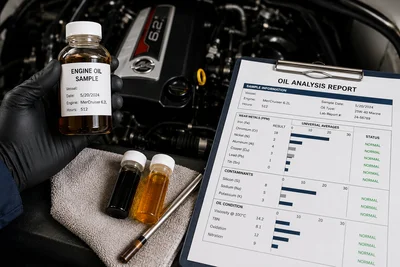
Most oil analysis laboratories test for approximately 22 different elements during a pre-purchase inspection. These include metals, contaminants, and additives that may indicate normal engine wear or potential problems.
The key is understanding the results.
Every element has acceptable thresholds measured in parts per million (PPM). Unfortunately, some reports use vague terms like "positive" or "negative" instead of reporting the actual concentration. For example, a "positive" glycol reading could represent 10 parts per million — which is essentially insignificant — or 250,000 parts per million, indicating a serious coolant leak. Without the actual numbers, those results can be misleading.
Don't Let One Lab Report Kill a Good Deal
Too often, otherwise excellent deals fall apart because buyers misunderstand oil analysis results.
The buyer has already invested thousands of dollars in inspections, travel, and surveys. The seller loses valuable time and may have to start the entire sales process over again. All because a lab report was interpreted without understanding what the numbers actually mean.
The fact is, many engine manufacturers acknowledge that certain elevated readings are not necessarily cause for concern. For example, Cummins has stated that elevated copper levels alone may not indicate a mechanical problem.
Yet many buyers are unnecessarily alarmed because they receive incomplete or poorly explained lab results.
Oil Analysis Works Best as a Trend, Not a Snapshot
The real value of oil analysis is monitoring trends over time.
Imagine managing a fleet of 500 trucks. If one engine suddenly shows a dramatic increase in sulfur, glycol, or wear metals compared to previous samples, that's valuable information because you have a history to compare against.
A single oil sample taken during a pre-purchase inspection doesn't provide that historical baseline.
Without previous reports, most findings simply establish a starting point for future maintenance rather than offering a definitive assessment of engine condition.
Serious Engine Problems Usually Reveal Themselves
The irony is that many significant engine issues don't require a laboratory to discover. Excessive coolant contamination often turns engine oil into a milky mixture that's obvious on the dipstick. Worn crankshaft bearings typically produce low oil pressure or noticeable engine noise. Severe internal wear usually leaves other mechanical clues that an experienced marine technician will identify during a proper inspection.
Oil analysis may confirm those findings, but it rarely discovers catastrophic problems that aren't already obvious in a comprehensive inspection.
The Bottom Line Before You Buy Your Next Boat
By all means, include an oil analysis as part of your pre-purchase inspection. It's an excellent maintenance tool and provides a valuable baseline for future service. Just don't treat a single lab report as the final word on the health of a marine engine.
If you're preparing to buy your next boat, make sure your inspection team understands how to interpret oil analysis results in context. You don’t want them to simply react to numbers or vague "positive" findings. Ask for the actual parts-per-million readings, review the manufacturer's service bulletins, and rely on experienced mechanics who know how to combine laboratory data with real-world engine diagnostics.
When you're making a six-figure investment, it is informed decisions, not some numbers on a lab report, that protect both buyers and sellers.