
There's one sound every boater dreads. You hit the starter button 50 miles offshore and instead of your engine roaring to life, you hear click, click... and nothing.
Dead boat batteries are one of the most common—and most preventable—problems on the water.
I've spent more than 50 years around boats and marine engines, including time with Cummins, Caterpillar, and Detroit Diesel. During that time I've watched marine battery technology evolve from simple flooded batteries to today's AGM and LiFePO4 systems. This isn't intended to be a technical engineering lesson. It's the real-world information every boat owner should know before heading offshore.
Whether you're buying new marine batteries or simply trying to make your current battery bank last longer, understanding a few basic principles can save you thousands of dollars—and maybe even save your day on the water.
Marine Battery Types: How Far the Technology Has Come
Not long ago, the only battery most boat owners ever considered was a traditional flooded lead-acid battery.
I almost called it "old-fashioned," but that really wouldn't be fair. Flooded batteries did exactly what they were designed to do, and they did it well for well over a century.
Today, however, boat owners have more choices than ever:
Flooded Lead-Acid Batteries
Gel Batteries
AGM (Absorbent Glass Mat) Batteries
LiFePO4 (Lithium Iron Phosphate) Batteries
Deep Cycle Batteries
Dual-Purpose Batteries
Each has advantages, disadvantages, and applications where it makes the most sense.
Flooded Lead-Acid Batteries
A flooded battery is simply lead plates submerged in an electrolyte solution—typically sulfuric acid—which creates DC electricity through a chemical reaction.
They're inexpensive, dependable, and still a perfectly acceptable choice for many boat owners.
The tradeoff is maintenance.
If your batteries aren't sealed, you'll need to periodically check the electrolyte level and top them off with distilled water.
Most boats remain plugged into shore power with the onboard charger left on continuously, which is perfectly fine. Just remember that even though the charger cycles into "float mode," water is slowly lost over time and still needs to be replaced.
Gel Batteries
Gel batteries are similar to flooded batteries except the electrolyte is suspended in a gel instead of liquid.
That means:
No fluid checks
No adding distilled water
Better vibration resistance
Lower maintenance
They remain a solid option, although they've largely been replaced by AGM batteries in many marine applications.
AGM (Absorbent Glass Mat) Batteries
This is where things start getting interesting.
If someone asked me what battery offers the best balance of performance, maintenance, reliability, and cost, my answer would almost always be AGM.
Yes, they cost more.
Yes, they're heavier.
But they perform exceptionally well.
Here's a real-world example anyone can understand.
My Harley-Davidson, with a traditional flooded battery, won't start after sitting three weeks without a battery tender.
After installing an AGM battery, it starts after sitting for nearly three months.
Case closed.
That's not marketing hype.
That's experience.
AGM batteries also eliminate fluid maintenance and generally tolerate vibration much better than flooded batteries.
LiFePO4 (Lithium Iron Phosphate) Batteries
LiFePO4 batteries represent the latest evolution in marine battery technology.
They're remarkably light—often weighing around half as much as an equivalent AGM battery—and provide significantly more usable capacity.
Unlike traditional lead-acid batteries, lithium batteries can safely be discharged much deeper before recharging.
That doesn't mean you should regularly run them completely dead because doing so still shortens their lifespan.
The difference is they survive deep discharge far better than flooded or AGM batteries.
If budget isn't a concern, they're an outstanding choice.
For many boat owners, however, AGM batteries remain the sweet spot between cost and performance.
Before switching to lithium, check with your engine manufacturer.
Companies including Mercury and Yamaha publish approved lithium battery lists for engine starting applications. Using an unapproved battery could affect warranty coverage.
Five minutes with your dealer before purchasing can prevent expensive headaches later.
Marine Battery Comparison
Battery Type
Maintenance
Weight
Expected Life
Best For
Flooded
Check fluid regularly
Heavy
3–5 years
Budget-conscious owners
Gel
None
Heavy
4–6 years
Low-maintenance owners
AGM
None
Heavy
6–7 years
Most recreational boaters
LiFePO4
None
About half the weight
10+ years
Maximum performance
Starting Batteries vs. House Batteries
One of the biggest mistakes I see is improper battery arrangement.
Redundancy and isolation should always be your first priority.
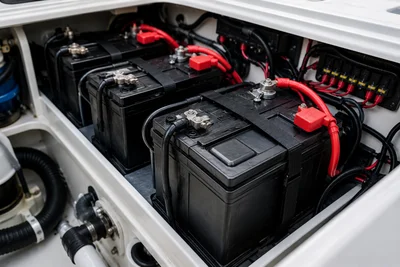
Each engine should have its own starting battery that remains isolated from the others.
Your electronics, lights, pumps, and accessories should operate from a separate house battery bank.
Why?
Because if you've been anchored all day running stereos, electronics, and lights, you want those house batteries to discharge—not the batteries that need to start your engines.
The goal is simple:
You should always be able to start your engines.
Battery selector switches exist for exactly this reason. Learn how yours work before you actually need them.
Generator Batteries and Charging
Generators deserve a mention because they're often misunderstood.
I've seen generators with over 20,000 operating hours that still weren't worn out.
Generator engines are designed to run.
Don't be afraid to let them.
While anchored, the safest approach is often to leave the generator running so your onboard battery charger keeps everything fully charged.
Another quirk many boat owners don't realize is that on numerous boats the generator starting battery only charges while the generator itself is running.
It may not receive a charge from the engine alternators or even the onboard charger.
Know how your particular boat is wired.
Don't Drain Every Battery on the Boat
This is where good battery management matters.
Personally, I'm not a fan of running refrigerators from the DC battery bank unless absolutely necessary.
If you have a generator, run the refrigerator on AC power.
If you don't have a generator, your food will stay cold plenty long enough for a day trip with the refrigerator off.
I'd rather lose a little convenience than lose every battery onboard.
Understanding Battery Size, CCA & Amp Hours
Battery sizes such as Group 24, Group 27, Group 29, and Group 31 generally indicate increasing physical size and capacity.
Two specifications matter most.
Cold Cranking Amps (CCA)
CCA measures the battery's ability to deliver starting power.
More CCA generally means more cranking capability.
Amp Hours (Ah)
Amp Hours measure how long a battery can provide power.
Personally, I pay closer attention to Amp Hours than almost anything else because they're a better indicator of real-world endurance.
A Group 31 battery generally provides more capacity than a Group 24 if both use the same battery technology.
Battery Maintenance Every Boat Owner Should Do
Fortunately, battery maintenance isn't complicated.
Spend just a few minutes every couple of weeks checking:
Battery terminals are clean and tight.
Flooded batteries have proper fluid levels.
Batteries are securely fastened.
Chargers are compatible with your battery chemistry.
Battery switches are in the proper position.
No cables show corrosion or loose connections.
One thing I've learned over the years is this:
A 30-second inspection before heading offshore can prevent a very expensive day.
Loose Battery Connections Can Fool You
This one always starts debates.
Over the years I've seen batteries with loose or badly corroded terminals that would still power accessories but wouldn't properly recharge.
The result?
Everyone blames the battery.
Maybe engineers have an explanation.
I don't.
I only know what I've personally seen after five decades around boats.
Pay attention to what actually happens—not just what someone says should happen.
Marine Battery Chargers Matter Too
Not every battery is charged the same way.
AGM batteries require charging profiles different from flooded batteries.
LiFePO4 batteries typically require chargers specifically designed for lithium chemistry.
Modern smart chargers also include safety systems that sometimes refuse to charge batteries that have been discharged too deeply.
The theory is preventing fires.
The downside is obvious.
Imagine being 80 miles offshore with your generator running but your onboard charger refusing to charge because your batteries are already too dead.
Sometimes common sense gets lost somewhere between the engineering department and the real world.
Frequently Asked Questions
How long do marine batteries last?
Flooded batteries generally last 3–5 years.
Gel batteries typically last 4–6 years.
AGM batteries commonly last 6–7 years.
LiFePO4 batteries often exceed 10 years with proper charging and maintenance.
Can I replace AGM batteries with lithium?
Yes, but only if your charger, alternator, and engine manufacturer support lithium batteries.
Always verify compatibility before making the switch.
Should I leave my battery charger on all winter?
Yes.
Modern smart chargers are designed to maintain batteries through float charging.
Just remember to periodically inspect flooded batteries and replenish distilled water as needed.
What is the difference between a starting battery and a deep-cycle battery?
Starting batteries deliver high current for a short period to crank engines.
Deep-cycle batteries are designed to provide lower current over much longer periods, making them ideal for house battery banks.
Bottom Line
Battery technology has come a long way.
Flooded batteries still work.
AGM batteries offer what I believe is the best balance of cost, reliability, and performance for most recreational boaters.
LiFePO4 batteries represent the future and offer incredible performance if you're willing to invest in them.
No matter which battery you choose, the fundamentals never change.
Keep your terminals clean.
Keep batteries securely mounted.
Use the proper charger.
Know which battery bank you're using.
And don't wait until you hear click, click 50 miles offshore to discover something wasn't maintained.