
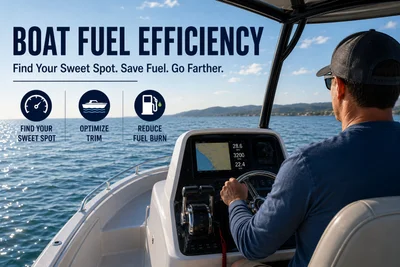
Every Boat Has a Fuel Efficiency Sweet Spot
Every boat buyer who becomes a boat owner wants to figure out how to get the most out of their fuel because even efficient boats burn a lot of fuel. Every boat has a fuel efficiency sweet spot where performance is maximized with comparative fuel burn.
For example, if your vessel is burning 35 GPH (gallons per hour) at 28 knots and you throttle up to 30 knots, your fuel burn may jump disproportionately to 42 GPH for the extra two knots. You have passed that boat's sweet spot.
Gas or diesel, inboard or outboard—it doesn't matter. EVERY vessel has a sweet spot for that exact setup on that specific boat. Engine selection, horsepower, and boat type all determine the best cruise speed and RPM for maximum boat fuel economy.
You can learn to hear it. When you hear the engines roar, you've pushed the throttles too far.
Finding the Best Cruise RPM for Maximum Fuel Economy
In the scenario above, at 30 knots, if you pull the throttles back perhaps 100 RPM below that loud roar, the engines immediately become a much quieter hum.
To be clear, the sound will transition from a scream to a normal engine-running sound.
I promise this is real. You're hearing the engines working too hard. Pull the throttles back slightly and the noise instantly becomes dramatically quieter.
That's your sweet spot.
Note the RPM and fuel burn.
Almost all engines today display gallons per hour (GPH) on the engine gauges, making it much easier than the old days of needing a FloScan gauge to determine accurate boat fuel consumption.
Truth be told, when you find that specific speed in conjunction with engine RPM and determine the most fuel-efficient cruising speed for your boat, yacht, or PWC, you don't need much more reporting on fuel burn.
Diesel Engine Load, RPM & Fuel Efficiency
Diesel engine gauges show the percentage of engine load, which means if the engines are rated at 1,000 horsepower (HP) and the gauges indicate 80% load, the engines are developing approximately 800 HP.
Almost all diesel engine manufacturers recommend operating at no more than 80% of maximum governed RPM, as consistently exceeding that level can significantly shorten engine life. As a side note, 80% engine load is rarely the sweet spot for the most efficient RPM or the best fuel efficiency.
Most outboard engines are rated at 6,000 RPM, meaning the rev limiter prevents the engine from exceeding that speed. The most efficient RPM varies from boat to boat, but 4,000 RPM is an excellent starting point when searching for your boat's fuel-efficient sweet spot. You may find that your ideal cruising RPM is closer to 4,200 RPM, give or take a little.
However, 80% of maximum RPM on a 6,000 RPM outboard is 4,800 RPM, which is often far too high for optimal fuel burn and fuel economy. It may be fun because your boat is flying, but your fuel burn gauge will quickly show how much that extra speed costs. Be prepared to be shocked by how dramatically fuel consumption increases for only a small gain in speed.
Boat Fuel Consumption: How Cruising Speed Affects Fuel Burn
In years past, experts said the rule of thumb was simple: a 40-foot boat burns 40 gallons per hour (GPH), while a 50-foot boat burns 50 GPH. That old adage is largely gone. Today's large sportfishing boats with incredibly fast cruising speeds often exceed that formula but so have the speeds themselves. What was once considered an unheard-of cruise speed is now the norm.
An acceptable boat cruising speed continues to increase almost every year. It wasn't that long ago that a 20-knot cruise was considered fast enough. Today, you would have a very hard time selling a boat that cruises that slowly.
Some styles of boats burn substantially less fuel than the old rule suggests, but they are also much slower. One thing is written in blood: the faster you go, the more fuel you will burn, regardless of the type of boat.
For example, a 45-foot trawler cruising at 12 knots may sip fuel at just 10 to 12 GPH. That same boat, or a so-called fast trawler, traveling at 20 knots may burn 35 to 40 GPH. The extra speed comes at a price—and that price is fuel.
As the saying goes, the nicer the ride, the higher the price.
Choosing the Right Boat Cruising Speed: Fuel Economy vs. Performance
Everyone needs to be realistic about what an acceptable boat cruising speed is for their own boating style. It is very common for sailboat owners to purchase a trawler, especially as they get older, because going fast was never their priority.
On the other hand, large sportfishing boats traveling 100 miles or more in each direction have a good reason to maintain a fast cruise speed, especially tournament fishermen. More time on the fishing grounds means more time with lines in the water and a better chance of winning a big purse. In reality, it is often about the competition as much as the prize money.
Imagine a beautiful 72-foot Viking cruising at 35 knots while burning 150 gallons per hour (GPH). On a $7 million boat, it is probably safe to assume the owner is not overly concerned about fuel costs. That owner belongs at 80% engine load to protect the engines from unnecessary wear, but in this case, speed is more important than fuel economy.
Boat Trim and Fuel Efficiency: How Proper Trim Saves Fuel
Boat trim is a huge factor in fuel efficiency and overall boat performance. For beginners, trim is the angle of the boat as it travels through the water—bow up, bow down, and side to side.
Outboard boats respond more to engine trim (tilt) than to trim tabs. Most boats use both, but three large outboards have a tremendous effect on the boat's running angle. On outboard-powered boats, trim tabs are used more to correct the boat's side-to-side angle. If you have more weight on one side than the other, rather than letting the boat list, adjust the trim tabs to bring the boat back to an even, horizontal position.
I have personally found that simply pecking at the engine trim buttons is often all it takes to fine-tune the bow-up or bow-down angle. On a choppy day, most boaters raise the bow to stay drier in sloppy seas. That's a good idea, but you also need to understand that fuel efficiency will suffer with the bow riding too high.
Inboard boats must rely almost entirely on trim tabs to adjust both the bow angle and the boat's side-to-side attitude because the propeller shafts are fixed.
When trimming any boat—inboard or outboard, gas or diesel—watch the wake behind the boat. As you adjust the bow up or down, you'll notice the wake becoming larger or smaller. The smallest wake you can achieve is usually the most efficient running angle, delivering the best combination of fuel efficiency, boat speed, and overall performance.
Engine Longevity, Horsepower & Fuel Efficiency
Here's the bomb, gang. It's not that I like controversy; it's that there are so many myths about boats perpetuated by people who want to sound knowledgeable but, in fact, are not.
Something almost magical happens when an engine is derated. Many years ago, a 500-cubic-inch engine developed around 150 horsepower and routinely lasted 50,000 hours. Today's engines are rated at incredible horsepower numbers. That same 500-cubic-inch engine may produce 600 to 700 horsepower. The tradeoff is engine longevity. A few thousand hours between major overhauls have become the norm.
The point is that a derated engine will burn significantly less fuel. I have personally seen big-block gasoline engines burn less fuel than small-block engines at normal cruising speed because they produce the required horsepower at lower RPM. Wind those same big blocks up to full throttle, however, and they will absolutely burn more fuel. I'll be writing an entire blog soon on engine longevity, horsepower ratings, and fuel efficiency.
The good news is that we all have the ability to derate our engines simply by pulling the throttles back. Higher RPM means higher horsepower—but it also means shorter engine life.
Pull the throttles back, and you'll burn substantially less fuel, extend the life of your engines, and reduce engine noise so you can enjoy your time on the water in a more peaceful environment. Unless it's an emergency, there's no intelligent reason to stand behind your engines with a whip. Push them hard every time you leave the dock, and you'll burn dramatically more fuel, shorten engine life, and eventually pay for it with expensive engine repairs or replacements.
Frequently Asked Questions
What is the most fuel-efficient speed for a boat?
Every boat has a unique fuel-efficiency sweet spot based on its hull, engine, propeller, and weight. The best cruise speed is where fuel burn is lowest for the speed you're traveling.
Does slowing down save boat fuel?
Yes. Even reducing engine speed by 100–200 RPM can significantly reduce fuel consumption while making the engines quieter and extending engine life.
Does trim affect fuel economy?
Absolutely. Proper trim reduces drag, creates a smaller wake, and improves both fuel economy and overall boat performance.
Is diesel more fuel-efficient than gasoline?
Diesel engines are generally more fuel-efficient than comparable gasoline engines because they produce greater torque at lower RPM. However, every boat still has its own optimal cruising speed and RPM.
Does boat weight affect fuel efficiency?
Yes. Additional passengers, full fuel tanks, water, gear, and improper weight distribution all increase drag and fuel consumption. Keeping weight balanced and carrying only what you need can improve fuel economy.
How can I measure boat fuel efficiency?
The easiest method is to compare gallons per hour (GPH) against your GPS speed. The most efficient cruising speed is typically where you travel the greatest distance for every gallon of fuel burned.